
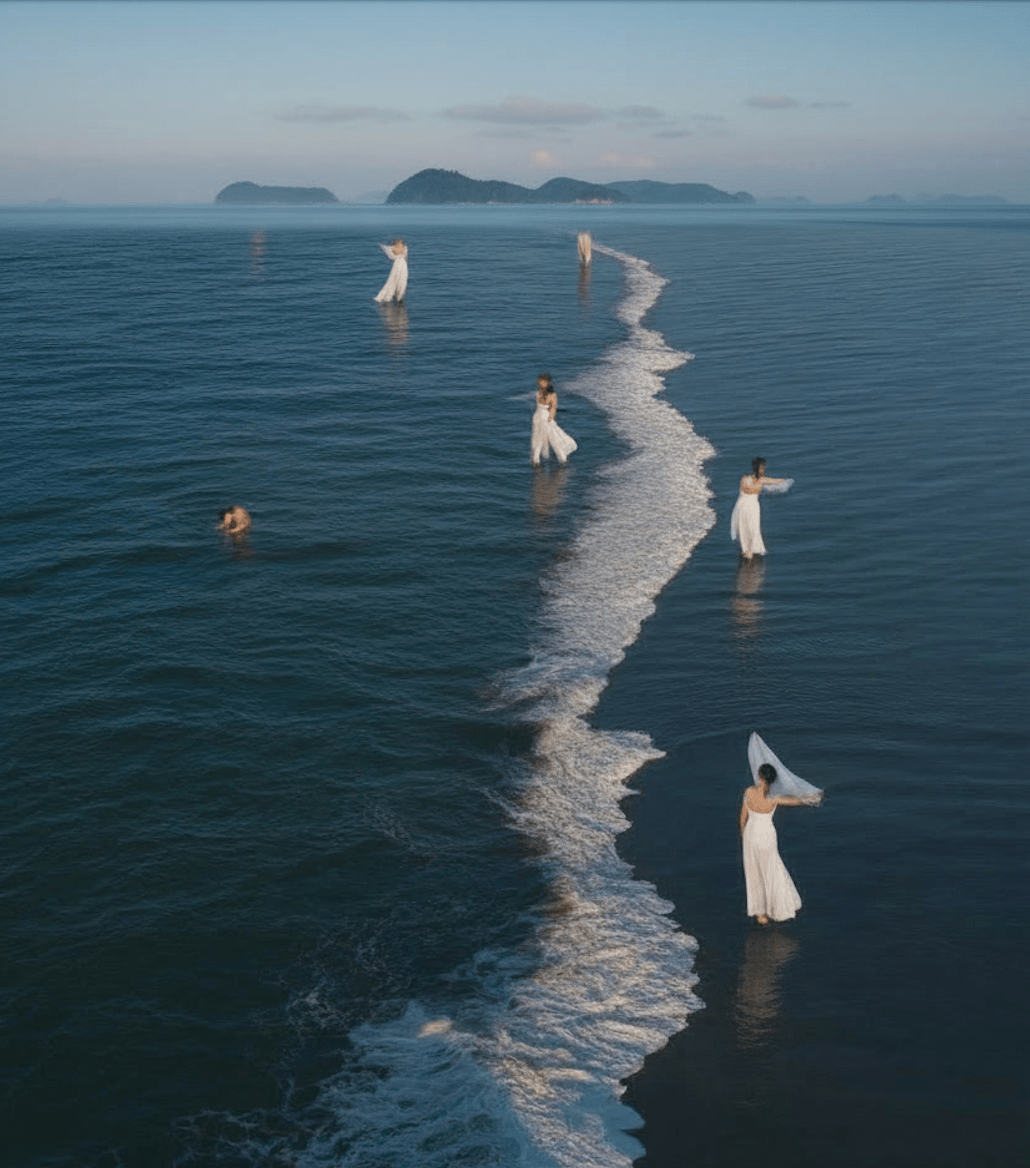
A Participatory Art‑Yoga Performance within
Interwoven Coasts: Art as Dialogue in the East Asian Mediterranean
Fujii Gallery, Fukuoka, Ito Campus · 9 & 16 December 2025
There are moments when research leaves the page, when theory becomes breath, and when an exhibition space turns into a living organism. The two happenings of “Interwoven Bodies: Ode to the Living”, created and performed by Dr. Charlène Clonts, unfolded precisely in that fragile, luminous zone where art, embodiment, and collective presence touch. Conceived within the exhibition Interwoven Coasts: Art as Dialogue in the East Asian Mediterranean, curated by Gloria Yu Yang & Anton Schweizer (thank you so much for your invitation; thank you also to the artists and the participants of the events), the performances transformed the Fujii Gallery into a site of ritual, encounter, and shared movement.
(See: Explanatory leaflet at the end of this article)
A Living Gesture in an Interwoven Space
Described as “not a finished form but a living process—open, participatory, and co‑created with those present”, the happenings invited participants to step into an artistic experience shaped as much by presence as by choreography.
No one arrived merely to observe. Everyone became part of a breathing tableau.
Drawing on walking meditation, soundscape, poetry, music, dance, and Art‑Yoga, the performances created a sensory field in which bodies, voices, images, and sonic textures wove themselves into a unified aesthetic experience. The gallery, filled with coastal memories and material traces of East Asia and the Mediterranean, became the stage for an intimate ode to life.
Landscapes in Motion
The artistic gesture emerged from specific landscapes visited during the preparatory stages of the performance:
Sefa Utaki in Okinawa,
Futamigaura in Itoshima,
and the coastal sanctuaries of Fukuoka — sites that inspired the meditative and choreographic motifs.
These East Asian seascapes conversed with the performer’s own roots along the Mediterranean coast, evoking an embodied dialogue between continents, memories, and tidal rhythms.
The first happening, created for artists, curators, organizers, and the gallery team, unfolded as a walking meditation guided by a soundscape drawn from waves, fire, voices, Okinawan songs, and textures from the exhibited artworks. Movements surfaced organically — from stillness to fluidity — responding to and echoing the resonance of the space. This closed session was video‑recorded as part of the exhibition’s co‑creative archive.
The second, public happening expanded the encounter, inviting participants to move and breathe within electroacoustic compositions, poetry readings, and the shifting light of the gallery. For one hour, the gallery became a sanctuary of shared pulse and relational presence.
Art‑Yoga as Research‑Creation
“Interwoven Bodies” is rooted in the Well‑Being with Arts project at Kyushu University, where Art‑Yoga serves as a research‑creation method blending somatic awareness with artistic expression.
The approach merges:
- meditative movement,
- aesthetic attentiveness,
- sound‑driven improvisation,
- and relational co‑presence.
The result is an embodied inquiry: a question asked through movement, not words.
As the leaflet explains, Art‑Yoga becomes a bridge between body and artwork, transforming the exhibition into a living ecological system of gestures and gazes.
Echoes of Dance and Poetic Practice
The choreographic language paid homage to several artistic lineages:
- Maurice Béjart, whose vision intertwined yoga and dance into a celebration of vitality.
- Pina Bausch’s Tanztheater, where repetition, emotion, and embodied storytelling build spaces of tenderness and confrontation.
- Ghérasim Luca’s “practical poetry”, which Dr. Clonts has performed after the walking meditation and in other contexts, where spoken language becomes an act of breath, weight, rhythm — a bodily utterance.
These resonances were not quotations but atmospheres: quiet influences shaping how bodies met the space and how silence thickened into meaning.
Ode to the Living
At its core, “Interwoven Bodies: Ode to the Living” offered a moment of sanctuary.
An invitation to inhabit a form of togetherness that is slowed, attentive, and generous.
An act of care — for the body, the artwork, the exhibition, the coastlines that inspired it, and the community that gathered within it.
To stand in the Fujii Gallery on those December mornings was to feel how art can live through breath, and how a research‑creation project can echo through a room like a low tide drawing patterns in the sand.
Not a performance to watch.
A space to enter.
A life to share.
Author: Associate Prof. Dr. Charlène Clonts
Well-Being with Arts project
Kyushu University, Ito Campus, 744 Motooka, Nishi-ku, 819-0395 Fukuoka, JAPAN
A Kyushu University Institute for Asian and Oceanian Studies (Q-AOS) research module.
Copyright 2024 © Clonts Charlène WBA
Fièrement propulsé par WordPress
 Well-Being with Arts project